Non-Alcoholic Bar – What a Dry Bar Is and Why It’s Growing
-
Tomasz Wojtalewicz
Table of contents
Alcohol-Free Bar (Dry Bar): a New Hospitality Format or a Niche Experiment?
Just a few years ago, the concept of an alcohol-free bar was mostly seen as a curiosity or a temporary pop-up. Today, it increasingly appears as a fully fledged hospitality format—alongside cocktail bars, wine bars, and specialty cafés. The recurring question is: is the dry bar a lasting shift in the hospitality landscape, or merely a niche experiment aimed at a limited audience?
To answer this, we need to move beyond the simple narrative of “no alcohol” and look more closely at the role bars play today—and how the social function of alcohol itself is changing.
From a “0% option” to alcohol-free venues by design
The rise of alcohol-free bars began with the need for better alternatives in traditional venues. For years, a “0% option” meant lemonade, juice, or water—functional drinks, not part of the experience. With the development of the zero-proof category, drinks emerged that could genuinely stand their ground in a bar setting.
The dry bar is the next step in this evolution. It is not simply a bar without alcohol, but a space designed from the outset without it. Alcohol is not a missing element—it is intentionally excluded, serving as the foundation for the menu, rituals, and service language. This marks a fundamental difference from classic bars that merely add alcohol-free options.
Dry bars as a response to changing social roles of alcohol
For decades, alcohol acted as a social shortcut—signaling relaxation, evening time, or stepping out of work mode. Today, that function is increasingly blurred. Work-life boundaries are less defined, life moves faster, and consumer choices are more deliberate.
Dry bars respond to this shift. They do not reject the need for socializing, conversation, or ritual—they simply remove an element that, in many situations, has lost its relevance. This is why alcohol-free bars don’t compete directly with nightclubs, but rather sit somewhere between cafés, cocktail bars, and social spaces.
Why alcohol-free bars are emerging now (cultural and market timing)
The emergence of dry bars is neither accidental nor a passing trend. It results from several overlapping forces: improved quality of zero-proof drinks, changing attitudes toward alcohol, the growing visibility of Dry January, and the increasing role of hospitality as an experience rather than pure consumption.
The market has reached a point where an alcohol-free bar no longer needs to justify absence—it can exist as a value proposition in its own right. That’s why the first stable concepts emerged in large cities, where new hospitality formats have room to be tested and understood.
How alcohol-free bars differ from traditional bars with 0% options
At first glance, the difference may seem subtle—many traditional bars now offer alcohol-free cocktails. In practice, however, a dry bar operates according to a completely different logic. Here, the absence of alcohol is not a compromise or a special request, but the starting point for designing the entire experience—from menu and service to communication and guest expectations.
“Alcohol-free by design” vs. “alcohol optional”
The key distinction lies in intent. Traditional bars with 0% options follow an “alcohol optional” model—alcohol is the norm, alternatives are add-ons. Dry bars are alcohol-free by design: the concept, menu, service, and language function independently of alcohol.
As a result, the guest experience shifts from comparison to choice. There is no sense of substitution or compromise—only intention.
Why removing alcohol changes the entire business model
Eliminating alcohol affects everything: opening hours, guest mix, conversation dynamics, table turnover, even the soundscape and pacing of the evening. Dry bars are less about escalation and more about conversation, focus, and social presence.
Economically, they rely less on high-margin alcohol sales and more on experience quality, repeat visits, and a broader range of occasions—including daytime use.
What guests evaluate differently in a dry bar
In alcohol-free bars, guests pay closer attention to flavor, balance, and consistency. Without alcohol as a buffer, weaknesses are more visible. At the same time, atmosphere, service quality, and language play a greater role.
Ironically, dry bars are often judged more strictly than traditional bars—curiosity comes with the expectation that the entire concept must justify itself.
Which needs alcohol-free bars actually serve
Alcohol-free bars are not designed to replace alcohol or promote abstinence. Their role is broader: they meet the need for a grown-up experience without alcohol. This includes ritual, taste, social connection, and a break from everyday functionality—without the consequences many associate with drinking.
Bars as social spaces, not just places of consumption
At their core, dry bars fulfill a basic social need: being together without alcohol as a prerequisite. Conversations can last as long as the drink itself, without escalation.
For many guests, alcohol-free bars offer neutral ground—neither club, café, nor restaurant.
Zero proof as a format compatible with work, health, and mobility
Alcohol-free bars align naturally with modern lifestyles: after-work meetings, driving, early flights, or training the next day. Removing alcohol removes friction—and expands the number of valid occasions.
That’s why dry bars often operate at different hours than nightlife-focused venues and attract a more diverse audience.
Why dry bars are not “for non-drinkers,” but for conscious choice
A common misconception is that alcohol-free bars cater only to abstainers. In reality, most guests drink alcohol in other contexts—they simply choose differently in specific moments.
A dry bar is not an ideological statement. It’s a tool for choice—and that’s precisely why it has the potential to grow beyond a niche.
Alcohol-Free Bar Examples – Three Formats from Different Markets
Although the terms alcohol-free bar and dry bar are often used interchangeably, in practice they cover very different business models and cultural roles. This is not one single category of venues. It’s a cluster of formats that share one thing—no alcohol—while nearly everything else varies: the venue’s role in the city, operating hours, target audience, relationship with food service, and what guests expect from the experience.
When you look at alcohol-free bars that actually work across different markets, one thing becomes clear: what keeps a dry bar alive is not ideology, but format–market fit. The three examples below illustrate three different routes to the same need: a “grown-up” social drink experience without alcohol.
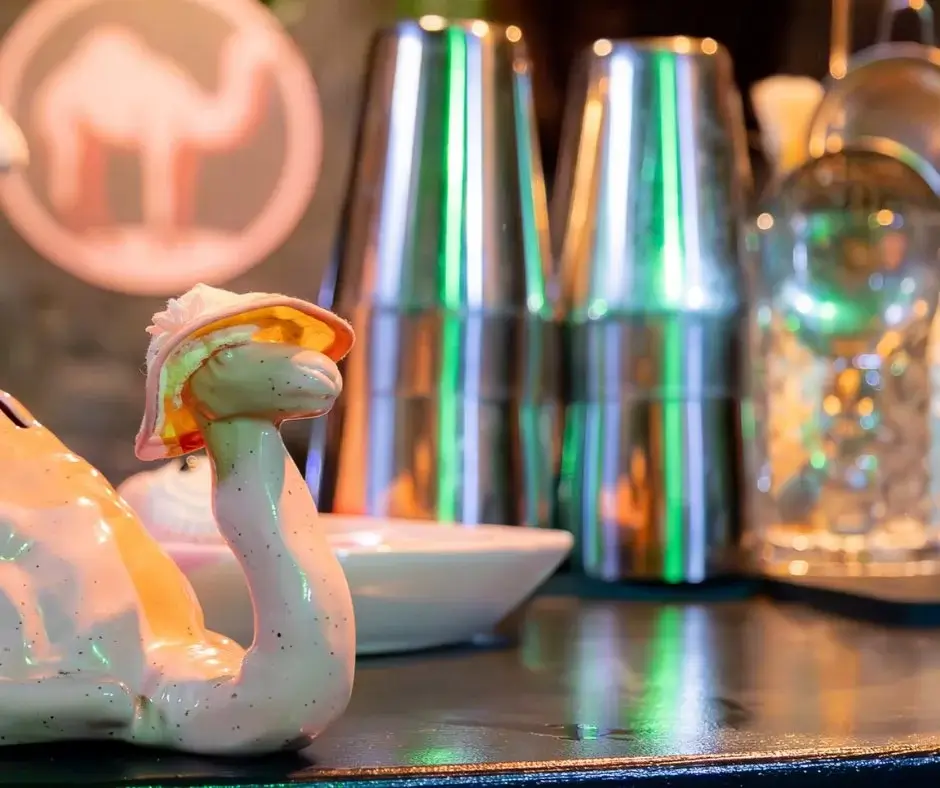
Dromader Dry Bar (Poland) – A Local Answer to the Need for “Adult Drinks Without Alcohol”
Source: https://www.facebook.com/p/Dromader-DRY-BAR-61556650312988/
Dromader Dry Bar represents a less flashy—but arguably one of the most realistic—models in Polish market conditions. It’s an alcohol-free bar built for local demand. It doesn’t try to compete with fashionable cocktail bars, and it doesn’t position itself as a dedicated zero-proof education hub. Its strength is normality: being a place to meet, not a manifesto.
What matters is what Dromader doesn’t do. It doesn’t apologise for not serving alcohol. It doesn’t frame itself as “for non-drinkers.” It doesn’t place guests in the position of being outside the norm. In that sense, it works by reducing social tension rather than amplifying it. Guests don’t need a reason to “not drink”—they simply come for a drink that happens to contain no alcohol.
This model shows that an alcohol-free bar in a small or mid-sized city has the best chance when it doesn’t try to copy Western concepts, but responds to a very specific local need: a social place without alcohol pressure—yet also without the feeling of being an “alternative.”
Zeroliq (Germany, Berlin) – A Zero-Proof Concept as Part of the Urban Bar Scene
Source (concept description): https://nuechtern.berlin/blogs/barguide/berlin-friedrichshain-zeroliq
Zeroliq operates in a completely different ecosystem than Dromader. Berlin is a city where diversity of bar formats is the norm. In that context, a dry bar doesn’t need to justify itself or fight for legitimacy—it’s simply one of many valid choices.
What’s key here is that the alcohol-free bar is not positioned as countercultural. It’s not framed as a reaction to alcohol as a problem. Instead, it sits naturally within an urban lifestyle where choosing 0% may be driven by work, daily rhythm, health—or simply preference.
This model suggests that in large cities, dry bars work best when they don’t isolate themselves into a separate “bubble,” but enter a conversation with the existing bar scene. Guests don’t come to “a bar without alcohol.” They come to a bar—with the difference that alcohol isn’t part of the offer.
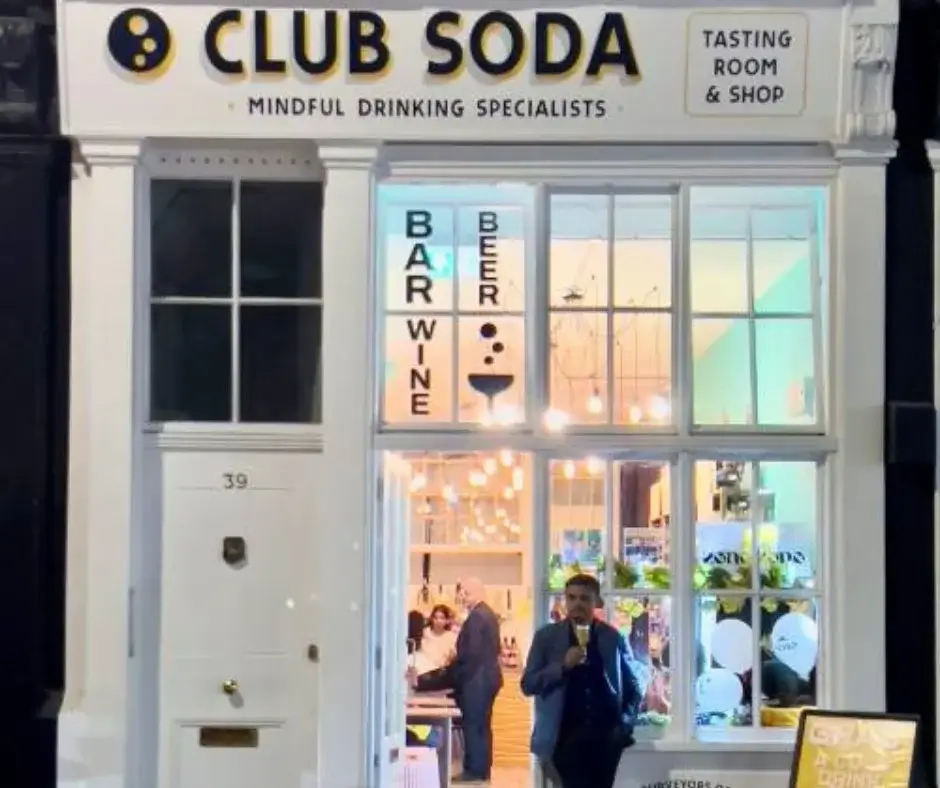
Club Soda Tasting Room (UK, London) – Tasting, Retail, and a Zero-Proof Community
Source: https://joinclubsoda.com/
The Club Soda Tasting Room is a format that intentionally moves away from the logic of a classic nightlife bar. Instead of competing for late-night occasions, it creates space for tasting, conversation, and discovery. It’s closer to a tasting room than a traditional bar—and that’s precisely why it works.
In this model, the alcohol-free bar becomes a point of intersection between several functions: education, retail, community, and a curated sensory experience. Alcohol isn’t the reference point, and zero proof isn’t “an alternative”—it’s the core language of the venue.
This format highlights an important insight: a dry bar doesn’t need to imitate the traditional bar model to be commercially viable and genuinely attractive. It can operate on a different rhythm, at a different pace, and often at different hours—serving needs that previously had limited infrastructure.
Why Some Dry Bars Disappear While Others Survive
The alcohol-free bar landscape is full of projects that disappeared after a few months. Not because the idea was wrong, but because it wasn’t anchored properly in market realities. In the case of dry bars, the “novelty factor” wears off quickly—and once it does, the venue must deliver a clear reason to exist beyond curiosity.
Permanent Venue vs. Pop-Up – What the Market Handles Better
Pop-ups and temporary projects have a built-in advantage: they don’t promise continuity. Guests come out of curiosity and accept that the experience is one-off. A permanent alcohol-free bar must answer a harder question: will people come back regularly?
Many dry bars struggle precisely at the point where they need to shift from “let’s see if this works” to daily operations. Without a consistent reason to return—quality, atmosphere, ritual—even the strongest concept can burn out.
The Expectation Problem: 0% Bars Are Judged More Harshly
Alcohol-free bars often enter the market with a much higher threshold of expectations. Guests test them more carefully, looking for proof that “this makes sense.” Every element—flavour, price, service, atmosphere—is measured not only against other 0% offers, but against bar culture as a whole.
In traditional bars, alcohol can mask weaknesses. In a dry bar, there’s no cushioning. If the experience doesn’t deliver, disappointment appears faster—and tends to be more final.
Price, Consistency, and the Question: “Would I Come Back?”
Price stops being the main issue only when the experience is consistent and repeatable. A single good drink does not build loyalty. The key question is what the guest thinks afterward: “that was interesting” or “that was worth repeating.”
Many dry bars lose at this stage—not because drinks are “too expensive,” but because they don’t provide a strong enough reason for a second visit.
The Alcohol-Free Bar as Part of an Ecosystem, Not a Standalone Point
The most stable zero-proof projects rarely operate in isolation. Instead of being a solitary dot on the city map, they embed themselves in a wider ecosystem—hospitality, hotels, food venues, or events—where they don’t have to constantly “explain” their existence. This allows alcohol-free bars to compete on more than just nightlife and benefit from existing traffic, occasions, and guest needs.
In practice, this means a dry bar often works better as part of a broader experience rather than the sole destination. It reduces business risk and accelerates category adoption—especially in markets where zero proof is still new for many consumers.
Collaboration with Restaurants, Hotels, and Events
Dry bars perform particularly well in contexts where alcohol can be limiting, inconvenient, or simply inappropriate: hotels, conferences, fine dining, industry events, cultural venues. In these settings, 0% drinks aren’t “the driver’s option”—they’re a logical choice that keeps everyone included.
This partnership also changes the traffic equation. The alcohol-free bar doesn’t need to generate demand from scratch. It benefits from guests who are already present. Instead of asking “should we go to an alcohol-free bar?”, the decision becomes “what should I order here?”—which dramatically lowers the barrier to entry.
Dry Bars as an “Incubator” for the Zero-Proof Category
For many consumers, the first real experience of high-quality 0% drinks happens in a bar, not in a store. That’s where perception shifts—from “alcohol-free product” to a full bar experience with glassware, service, pacing, and social context. This moment is often a turning point because it resets expectations for the entire category.
The impact extends beyond the venue. Guests start choosing 0% more confidently in restaurants, hotels, and at home, because they now have a quality benchmark. In that sense, the alcohol-free bar functions as an incubator: the category learns the market, and the market learns the category.
Why Many 0% Bars Start as Temporary Concepts
A time-limited project, pop-up, or tasting room is often a deliberate market-testing strategy—not a lack of ambition. It allows founders to test location, demand, communication language, price sensitivity, and whether customers are ready to engage regularly with 0% offerings.
For a young category like zero proof, this approach is rational. A permanent venue carries high fixed costs and expectations, while temporary formats provide flexibility and iteration. Many successful 0% concepts mature this way—from test to permanent presence—not the other way around.
How to Communicate an Alcohol-Free Bar Without Scaring People Off
In dry bars, language can matter more than the menu. The way a venue describes itself determines whether guests feel curiosity and openness—or distance and uncertainty. Communication can invite people in, or close the door before the first visit.
“Alcohol-Free Bar” vs. “Dry Bar” – How Language Works Across Countries
The phrase alcohol-free bar is clear and informative, but it can feel emotionally “heavy” because it highlights absence. Dry bar sounds lighter and more lifestyle-led, but it’s not universally understood and sometimes requires explanation. There is no single label that works equally well in every market.
The key is to match language to cultural context and market maturity. Some countries respond better to education-led messaging, others to aspirational or community-based framing. Rigidly sticking to one term is often less effective than flexibly shaping meaning.
Why “Without” Messaging Performs Worse Than “For Something” Messaging
Messaging built around absence triggers comparison: “what’s missing?” rather than “what’s offered?” A more effective approach is value-led communication: flavour, ritual, moment, experience quality. That shifts the focus from sacrifice to choice.
When an alcohol-free bar communicates through what it delivers, not what it avoids, it stops being an alternative—and becomes its own destination.
How to Tell the Dry Bar Story Without Comparing to Alcohol
The strongest zero-proof concepts barely mention alcohol at all. They talk about atmosphere, menu style, flavour inspiration, and social occasions. Alcohol stops being the reference point, and guests judge the venue on its own terms.
This lowers the barrier to entry because it doesn’t require the guest to declare “I don’t drink.” People can walk in out of curiosity, not justification.
Is the Alcohol-Free Bar a Format of the Future?
Dry bars won’t replace classic bars, but they are changing what “going out for a drink” can mean. They add flexibility and inclusivity to hospitality culture.
What Would Need to Change for Dry Bars to Stop Being a Niche
For the format to scale beyond niche, three elements must work together: access to high-quality 0% products, competent service, and the normalization of alcohol-free choice. When these conditions are in place, an alcohol-free bar stops being a novelty and becomes a legitimate option.
It’s less about mass adoption and more about consistency and repeatability—without the “tried it once, never again” effect.
Why 0% Bars More Often Work as Part of a Larger Concept
A standalone dry bar is a high-risk business and cultural proposition. Stability is easier when 0% is embedded within a hotel, restaurant, tasting room, or community project with an existing audience and context.
This is a natural maturation path: first coexistence, then specialization. The market learns the format gradually, not overnight.
Alcohol-Free Bars as a Test of Where Hospitality Is Heading
Dry bars are a litmus test for change in hospitality. They show that ritual, experience, and quality can exist without alcohol—and that choosing 0% doesn’t need to be explained or defended.
That’s why they matter: not as an end goal, but as a signal of the direction in which drinking and not-drinking culture is evolving.
Conclusion – The Alcohol-Free Bar as a Signal of Change, Not a Goal in Itself
The alcohol-free bar is not a revolution meant to replace classic bars, nor a quirky niche for a small group. It’s a clear signal that hospitality—and our relationship with alcohol—is shifting. The key question becomes not “how many percent?” but “why do we drink at all?”
Dry bars don’t define the only path forward, but they reveal the direction: where ritual, quality, context, and inclusivity matter, alcohol is no longer mandatory—just one option among several.
Dry Bar Not as an Alternative, But as a New Definition of “Going Out for a Drink”
The biggest shift is semantic. “Going out for a drink” stops automatically meaning alcohol and starts meaning time, place, social connection, and an experience that may or may not include alcohol.
In that sense, a dry bar doesn’t directly compete with classic bars. It expands the definition of going out—making it more flexible and aligned with modern life: work, mobility, health, and diverse social needs. Over time, this semantic shift influences real consumer behaviour.
What 0% Bars Tell Us About the Future of Drinking and Not-Drinking
If you treat 0% bars as a market barometer, one thing stands out: the future is not a simple split between “drinkers” and “non-drinkers.” The future is about managing context, occasion, and intensity. Alcohol becomes situational rather than default.
Alcohol-free bars show that drinking culture is evolving toward greater awareness—not bigger declarations. And that’s why they matter: not as a universal model, but as laboratories of new hospitality that test how drinking and not-drinking will look in the years ahead.